
Consumer groups, industry associations and medical experts call for policies that preserve consumer choice and recognize differences between cigarettes and smoke-free alternatives during the launch of the Philippine Harm Reduction Agenda, a science-backed, risk-based framework for consideration of national policymakers, which will be submitted to the Congress and the Department of Finance (DOF).
Consumer groups, industry associations and medical experts at the 2nd National Summit on Nicotine and Harm Reduction called for risk-based taxation of nicotine products and stronger action against illicit trade, as the government weighs proposals to ban vapes and heated tobacco products and to impose cigarette-level taxes on vapes.

Convenors launched the Philippine Harm Reduction Agenda—a science-backed, risk-based framework for national policymakers that they will submit to Congress and the Department of Finance (DOF).
The Philippine Tobacco Harm Reduction Advocates (PHILTRA) coalition convened the summit to discuss policies on cigarettes, vapes and other nicotine products.
Participants said taxes on smoke-free alternatives should not automatically match those on combustible cigarettes, particularly if policymakers want adult smokers to switch to less harmful products.
“Harm reduction policies can save lives, while total bans risk fueling illicit markets and relapse,” said Dr. Lorenzo Mata, president of PHILTRA co-convenor Quit For Good.
The summit also recognized the government’s need to raise revenue but cautioned that treating smoke-free alternatives mainly as a tax source could deprive smokers of another option to move away from cigarettes.
“We cannot look at these products only as another source of tax revenue. For smokers, they can also represent an opportunity to move away from cigarettes,” said Joey Dulay, president of the Philippine E-Cigarette Industry Association (PECIA).
Participants also highlighted the link between taxation, affordability and illicit trade. A study by the European Union-ASEAN Business Council (EU-ABC) and Euromonitor International found that 4 in 5 e-vapes on the market are untaxed, and estimated that illicit tobacco and vapor trade cost the government P141 billion in forgone excise tax revenue in 2024 and 2025.
Participants warned that higher taxes on legal alternatives, without stronger enforcement against illicit products, could push consumers toward cheaper, untaxed goods.
Medical experts discussed harm reduction, which seeks to lower the health risks of nicotine use by encouraging smokers who cannot or will not quit nicotine altogether to move away from combustible tobacco.
Speakers cited the experiences of Sweden, Britain, New Zealand and Japan, where smoking rates have declined alongside the availability of alternatives to combustible cigarettes. Sweden has reported a daily smoking rate of 3.7 percent, significantly lower than many other European countries, they said.
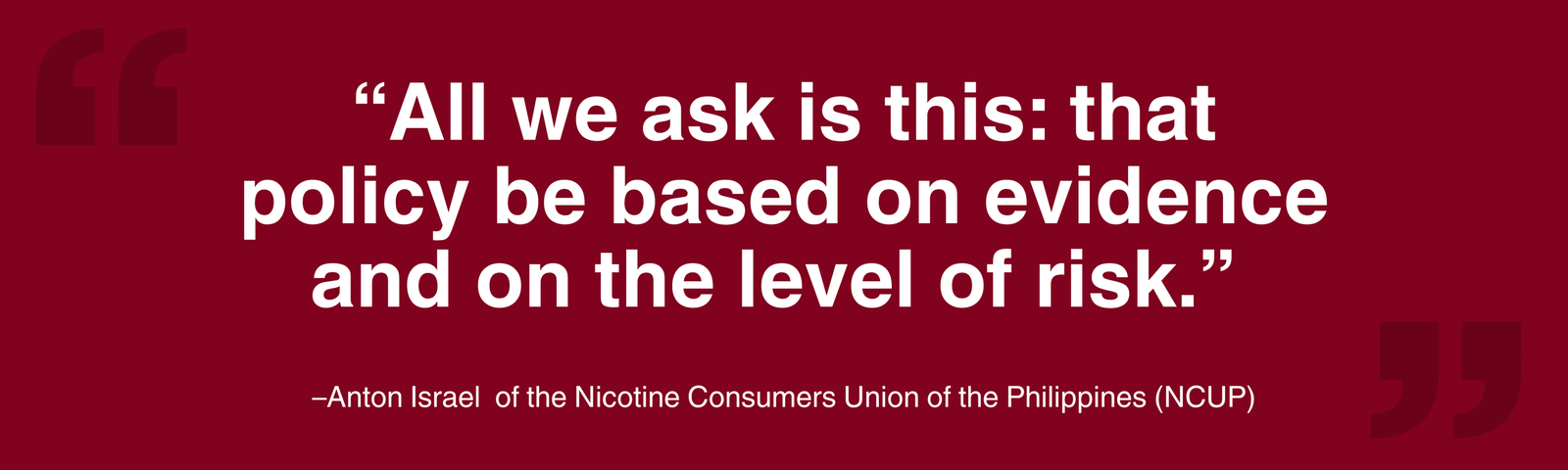
“All we ask is this: that policy be based on evidence and on the level of risk,” said Anton Israel of the Nicotine Consumers Union of the Philippines (NCUP), speaking in Filipino.
“The choice belongs to the Filipino consumer. Our duty is to make sure it is not lost, that they keep their access, their choice and their hope,” Israel said.
The summit also featured a visual exhibit, “When Choice Brings Hope,” showing Filipino consumers who said access to smoke-free alternatives helped them move away from cigarettes.
Participants called for stronger enforcement of existing regulations, particularly against illicit trade and youth access, while keeping risk-based distinctions between combustible cigarettes and smoke-free products.
The National Summit on Nicotine and Harm Reduction is hosted by PHILTRA, which comprises NCUP, PECIA, Quit For Good, Consumer Choice Philippines, VaperAko, Smokefree Conversations PH and the Science & Innovation Nicotine Advocacy Group (SINAG).
The summit examined how science-based harm reduction can be integrated into national tobacco control, focusing on smarter regulation, tax policies aligned with public health objectives, access to accurate consumer information and sustainable approaches to curbing illicit trade.