
Dr. David Nutt of Imperial College London
Cochrane, an internationally respected network of health researchers, has published a comprehensive review presenting strong evidence that nicotine-containing e-cigarettes can support adult smokers in quitting traditional cigarettes.
The systematic review, “Electronic cigarettes for smoking cessation,” drew on a large body of evidence. It examined 104 studies covering 30,366 adult smokers, with most data originating from the United States (48 studies) and the United Kingdom (21 studies).
The researchers assessed how nicotine e-cigarettes perform compared to other cessation methods, including nicotine replacement therapies (NRT), non-nicotine e-cigarettes, and behavioral support. Results showed that nicotine e-cigarettes were more effective than NRT options like patches and gum in helping smokers remain smoke-free for at least six months.
E-cigarettes, alongside nicotine pouches and heat-not-burn products, are considered tools for tobacco harm reduction—a pragmatic public health strategy designed to mitigate the risks of smoking. The latest Cochrane review contributes substantial evidence to ongoing global discussions on vapor product regulation, including in the Philippines where vaping use is on the rise.
The findings demonstrate a distinct benefit of nicotine-containing e-cigarettes, with data indicating that out of every 100 smokers who use them to quit, between eight and 11 remain smoke-free for at least six months.
The success rate surpasses that of conventional NRT, which help about six in 100 smokers quit. The review further indicates that nicotine e-cigarettes are likely more effective than non-nicotine versions, which show similar quit rates to NRT.
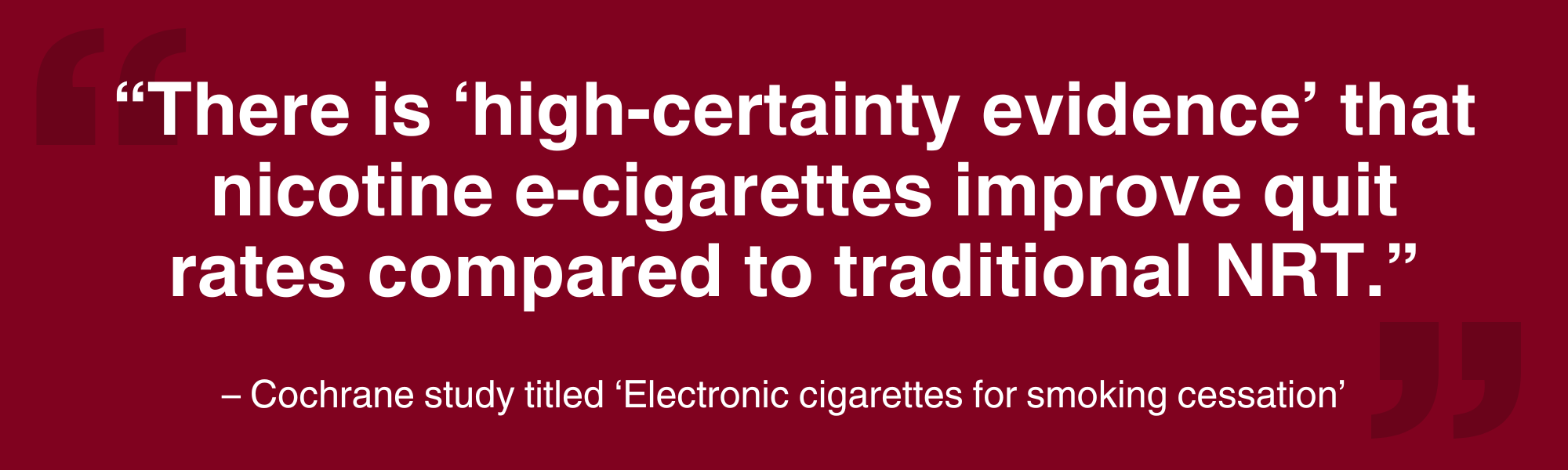
The study, led by Nicola Lindson of Oxford’s Nuffield Department of Primary Care Health Sciences, reached a conclusion with high confidence. It reported “high-certainty evidence” that nicotine e-cigarettes improve quit rates compared to traditional NRT.
The researchers also reported “moderate-certainty evidence” that nicotine e-cigarettes are more effective than non-nicotine versions, reinforcing the importance of nicotine delivery in their success.
The findings reinforce the rationale behind the Philippines’ Vape Law (Republic Act No. 11900), a measure that sets clear rules for these products, including age restrictions that bar sales to minors.
The Cochrane study results confirm that nicotine e-cigarettes are effective smoking cessation tools and represent a less harmful option than conventional cigarettes.
The Nicotine Consumers Union of the Philippines (NCUP) referenced numerous international studies indicating that vaping is approximately 95% less harmful than smoking traditional cigarettes, largely because e-cigarettes do not involve tobacco combustion. These studies emphasize that smoke, rather than nicotine itself, is the primary driver of tobacco-related disease and mortality.
E-cigarettes operate by heating a liquid—usually containing nicotine and flavorings—to create an inhalable vapor, thereby reducing exposure to the harmful chemicals found in cigarette smoke.
Vaper Ako, a consumer advocacy group, noted that less harmful alternatives like e-cigarettes and heated tobacco products have helped many Filipinos move away from the health dangers of smoking. “Adult smokers deserve access to accurate information and less harmful alternatives,” the group said.
Dr. David Nutt of Imperial College London said that scientific evidence clearly shows e-cigarettes and other less harmful alternatives are much safer than smoking and can support smoking cessation.
“Smoking causes a massive burden of death and disease worldwide, killing about 8 million people annually. We now have vaping and other less harmful alternatives to cigarettes that can dramatically cut the risks for people who cannot or do not want to quit using nicotine,” he said.
Dr. Nutt is among more than 40 independent experts in medicine, pharmacology, psychology, and public health who recently issued a joint statement calling on the World Health Organization (WHO) to strengthen its tobacco control strategy by following the science and embracing harm reduction.